
Mulch Volcanoes: Why Piling Mulch Against Trees Hurts Them
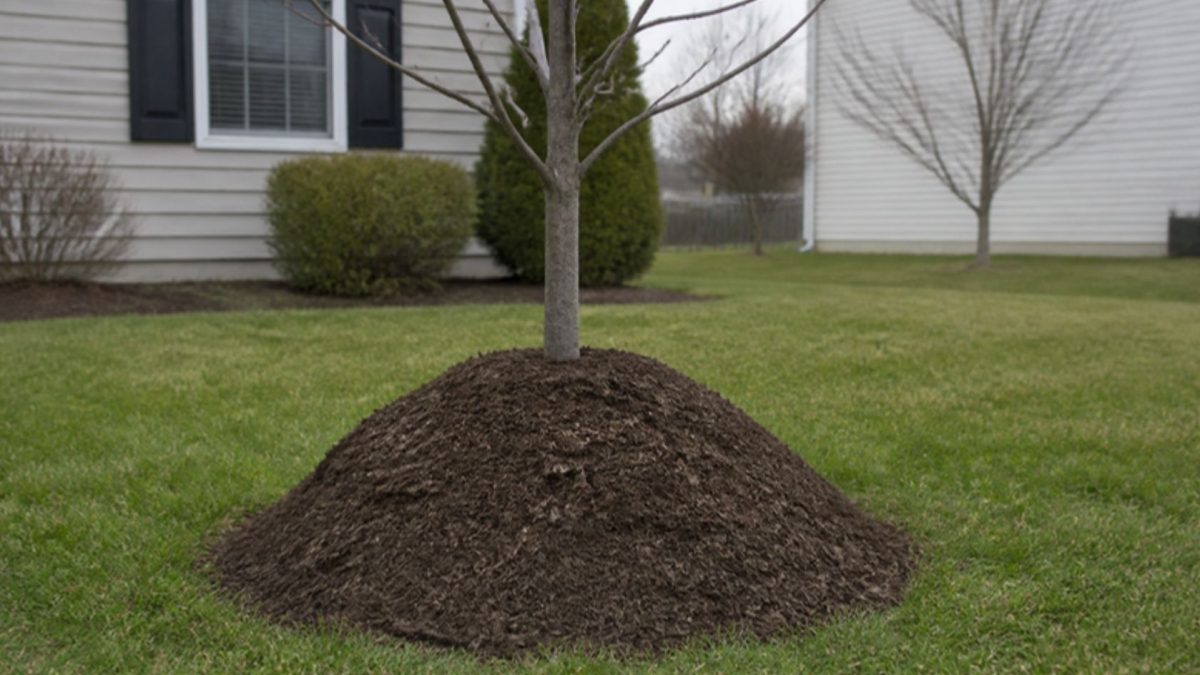
- A mulch volcano is mulch piled in a cone against a tree trunk. LSU AgCenter’s Dan Gill says mulch should never be mounded around the base of the trunk.
- Deep mulch against the trunk keeps the bark dark and moist, which lets decay organisms invade, according to Gill.
- Penn State Extension notes excess mulch can starve roots of oxygen and lead to roots that can girdle the tree.
- Recommended mulch for trees is a flat disk about 2 to 4 inches deep, pulled back from the trunk, extending toward the drip line.
- To fix a volcano, rake the old mulch out and away from the trunk rather than adding more on top.
You’ve seen them in parking lots, office parks and front yards all over the metro. A young tree rises out of a tall cone of mulch, piled a foot or more against the trunk. It looks tidy, and it looks like care, but tree specialists have a name for it because it causes so much damage.
At TurnKey Lawn Care, mulching trees and beds is part of the landscaping work we do across New Orleans. If the trees in your yard are sitting in mulch volcanoes, request a free estimate and we’ll reset them properly, with the price agreed before any work starts.
This guide explains what a mulch volcano is, how it harms a tree, and how to fix one and mulch the right way.
What a mulch volcano is
A mulch volcano is exactly what it sounds like: mulch piled up high around a tree trunk in a cone shape. In an LSU AgCenter article on garden don’ts, horticulturist Dan Gill writes that mulch should never be piled up in a mound around the base of the trunk, a practice that has been dubbed volcano mulching. It usually builds up over time. A fresh layer goes on each spring, the old layer underneath never gets raked out, and the pile climbs higher up the trunk every year. Some volcanoes are created on purpose, because a tall ring of mulch around a tree looks neat. The harm happens below the surface, where it’s easy to miss until the tree starts to decline.
How a mulch volcano hurts a tree
Tree bark is built to be exposed to air. A deep pile of mulch changes the conditions at the base of the trunk and the roots below, and several problems follow.
Bark decay
Gill explains that piling mulch deep around the base exposes the trunk to dark, moist conditions. The bark was never meant to protect the tree from that environment, and decay organisms can take advantage and invade the trunk. Penn State Extension says the same thing in its article on mulch volcanoes: when wet, the mulch holds too much moisture against the bark, which can cause it to break down. Gill’s guide to proper mulching adds that a cone of mulch against the trunk traps moisture and could lead to decay. In New Orleans, where rain and humidity keep mulch damp for much of the year, that moisture rarely gets a chance to dry out.
Roots short of oxygen
Roots need air as well as water. Penn State notes that too much mulch blocks roots from getting enough oxygen, and if the soil underneath stays too wet for too long, the roots begin to rot.
Girdling roots
Deep mulch can also change how a tree grows. Penn State explains that it can cause the tree to develop roots up in the mulch layer. As those roots grow in diameter, they can become girdling roots that wrap around the trunk and further restrict the tree’s ability to move water.
Mulch that repels water
A thick pile doesn’t always stay wet. Penn State points out that when hot, dry weather sets in and the mulch dries out completely, it can become hydrophobic and actually repel water, so rain and irrigation run off instead of reaching the roots.
Want this handled instead of doing it yourself?
Send the details and we will price it. Free estimate, no obligation.
Signs a tree is suffering
Damage from a mulch volcano develops slowly. Things to look for:
- Mulch piled several inches up the trunk, hiding where the trunk widens into the roots
- Soft, discolored or peeling bark at the base when the mulch is pulled back
- Roots growing up into the mulch rather than down into the soil
- Roots circling the trunk just below the mulch surface
- Thin canopy, small leaves or dieback on a tree that should be vigorous
Any of these is worth a closer look. A tree with a declining canopy may have more than one problem, so it’s worth having it checked. Our page on tree trimming covers the tree work we handle.
What proper tree mulching looks like
The right shape is a wide, flat ring. Gill recommends spreading mulch in a flat disk about 2 to 4 inches deep and pulled back slightly from the trunk. Other extension guidance lines up with that:
| Guideline | Recommendation | Source |
|---|---|---|
| Shape | Flat disk, not a mound | LSU AgCenter, Dan Gill |
| Depth | 2 to 4 inches | LSU AgCenter, Dan Gill |
| Depth | Preferably 2 to 3 inches | Penn State Extension |
| Distance from trunk | Keep mulch about 3 inches away; it should never touch the trunk | University of Maryland Extension |
| How far out | Toward the drip line, or as far as the branches spread | Penn State; University of Maryland |
| Grass-free zone | At least 2 feet out from the trunk | LSU AgCenter, Dan Gill |
The University of Maryland Extensi