
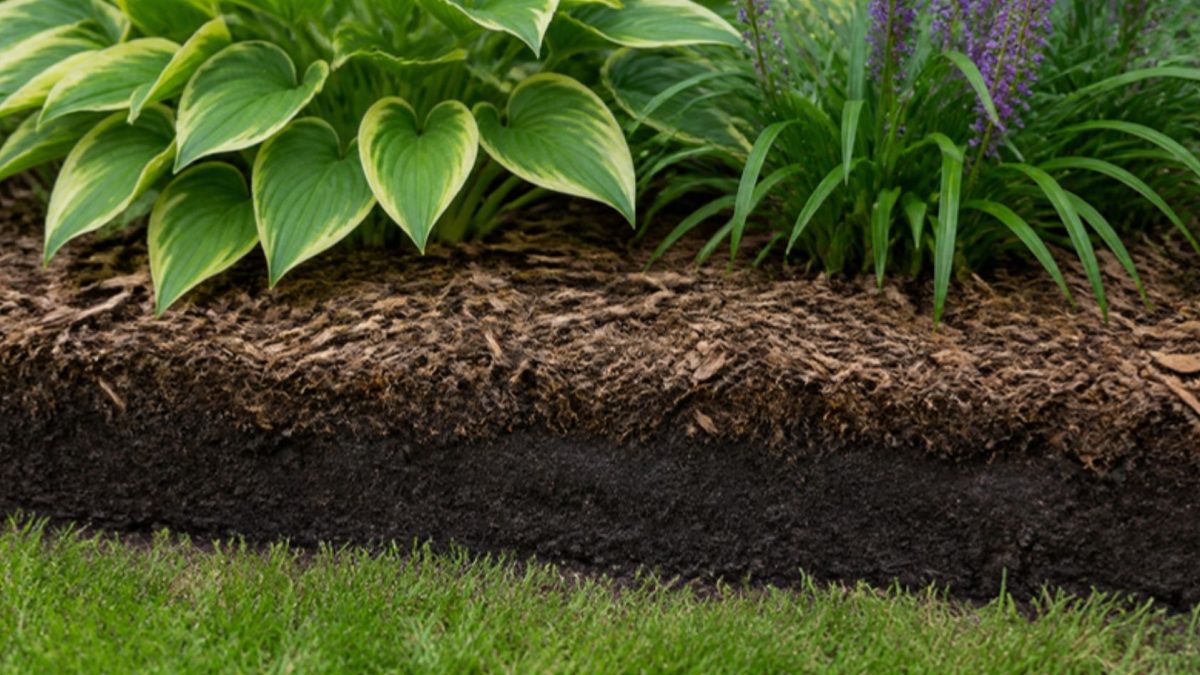
- LSU AgCenter puts the best overall depth for a mulch layer at 2 to 4 inches.
- LSU’s best-management guidance is 3 inches for trees, 2 inches for shrubs and 1 inch for bedding plants and perennials.
- UF/IFAS warns against going deeper than 3 inches in most beds, because excess mulch can divert water away from roots.
- Mulch piled against trunks and stems holds moisture and can cause rot, so leave the base of every plant clear.
- Organic mulch breaks down, so LSU recommends adding more once or twice a year, and UF/IFAS suggests topping up when depth falls below 2 inches.
- The short answer
- Recommended depth by plant type
- Depth by mulch type
- What happens when mulch is too thin
- What happens when mulch is too thick
- Keep mulch off trunks and stems
- How far out to mulch around trees
- How to measure and apply mulch at the right depth
- A seasonal mulch check
- How often to top it up
- Mulching lawn areas and around the yard
- Frequently asked questions
Most people buy mulch by eye. A few bags look about right, they get spread across the bed, and next spring a few more go on top.
After several years, some beds are buried under half a foot of mulch while others have worn down to bare soil in spots. Depth is the single detail that decides whether mulch helps your plants or works against them.
At TurnKey Lawn Care, mulching and bed maintenance are part of the landscaping work we do across the metro. If you’d like your beds refreshed at the right depth, request a free estimate and the price is agreed before any work starts.
This guide gives the recommended depths for Louisiana trees, shrubs and bedding plants, explains what goes wrong when mulch is too thin or too thick, and shows how to measure and maintain it.
The short answer
For most Louisiana beds, 2 to 3 inches of mulch is the target. LSU AgCenter horticulturist Heather Kirk-Ballard, in her article on mulch, puts the best depth for a mulch layer at 2 to 4 inches. The right depth within that range depends on what’s growing in the bed. Trees can take more mulch than shrubs, and shrubs more than bedding plants or new transplants. The type of mulch matters too. Fine mulches pack down and need less depth, while coarse mulches allow more air through and can be spread a little deeper.
Recommended depth by plant type
LSU AgCenter’s best management practices for planting and mulching give clear numbers: mulch trees to a depth of 3 inches, shrubs to 2 inches, and bedding plants and herbaceous perennials to 1 inch. Other extension sources fill in the details:
| Plant or bed | Recommended depth | Source |
|---|---|---|
| Bedding plants and herbaceous perennials | About 1 inch | LSU AgCenter best management practices |
| New transplants | No more than 1 inch at planting | LSU AgCenter, Dan Gill |
| Seedlings, small vegetables and herbs | About 1 inch | UF/IFAS Gardening Solutions |
| Shrubs | About 2 inches | LSU AgCenter |
| Established trees, shrubs and bedding plants | 2 to 3 inches | UF/IFAS Gardening Solutions |
| Young trees | About 3 inches, pulled back from the trunk | LSU AgCenter, Dan Gill |
| Older trees | 4 to 6 inches | LSU AgCenter, Dan Gill |
| Coarse mulch such as pine bark nuggets | Up to 4 inches | Clemson Extension |
The sources don’t agree on every number. Dan Gill’s LSU AgCenter guide to proper mulching allows 4 to 6 inches under older trees, while UF/IFAS Gardening Solutions advises against more than 3 inches in general. For most home beds, staying at 2 to 3 inches keeps you inside both recommendations.
Want this handled instead of doing it yourself?
Send the details and we will price it. Free estimate, no obligation.
Depth by mulch type
Different mulches settle differently. The Clemson Extension mulch factsheet recommends a 2- to 3-inch layer for pine needles, pine bark and shredded hardwood. It notes coarse-textured mulches such as pine bark nuggets allow good air movement and can be as deep as 4 inches. Finer mulches pack more tightly, so they’re best kept at the lower end of the range. Pine straw is light and fluffy when first spread and settles over the following weeks. LSU horticulturist Allen Owings, writing about pine straw mulch, recommends an initial 3-inch layer for shrubs and trees and slightly less around bedding plants, roses and herbaceous perennials. Our comparison of pine straw vs mulch covers how each material behaves in Louisiana’s heavy rain.
What happens when mulch is too thin
A thin layer gives up most of mulch’s value. LSU lists the benefits of a proper layer: it reduces moisture loss during dry periods, evens out soil temperature, improves the soil, suppresses weeds and reduces erosion. When the layer wears thin, those benefits fade. Signs your mulch is too thin: